Apogean
Selling a life that didn't exist yet.
Selling a life that didn't exist yet.
Beaver Capital • Vail, Colorado • 2025
Beaver Capital • Vail, Colorado • 2025
3D Rendering
VR Tours
Walkthrough & Lifestyle Video
Interactive Property Module
Website Design & Development

In the mountains above Vail, a nine-unit alpine residence was coming. Apogean had the things that matter most: a rare location, a clear vision, an established brand, and the kind of bones a building only gets once. What it didn't have was the one thing every buyer needed, which was a way to stand inside it.
Because the building didn't exist yet. And the people who could afford it were scattered across the country, being asked to commit serious money to something they could not visit, touch, or walk through. That's the real tension of presales: every buyer who leaves without believing isn't just a lost sale. It's weight on the whole project's timeline. We were brought in to answer one question. Could imagery build enough belief in an unbuilt home that someone serious is willing to sign, from anywhere in the world?
In the mountains above Vail, a nine-unit alpine residence was coming. Apogean had the things that matter most: a rare location, a clear vision, an established brand, and the kind of bones a building only gets once. What it didn't have was the one thing every buyer needed, which was a way to stand inside it.
Because the building didn't exist yet. And the people who could afford it were scattered across the country, being asked to commit serious money to something they could not visit, touch, or walk through. That's the real tension of presales: every buyer who leaves without believing isn't just a lost sale. It's weight on the whole project's timeline. We were brought in to answer one question. Could imagery build enough belief in an unbuilt home that someone serious is willing to sign, from anywhere in the world?
What we were given, and what was missing
What we were given, and what was missing
This is what every development has at this stage. Plans. Elevations. The architecture, stated in lines and measurements, precise and professional and completely silent on the only thing that actually sells a home: the life inside it. A drawing can tell you a ceiling is eleven feet. It cannot tell you how the morning comes through the glass, or what it feels like to arrive.
This is what every development has at this stage. Plans. Elevations. The architecture, stated in lines and measurements, precise and professional and completely silent on the only thing that actually sells a home: the life inside it. A drawing can tell you a ceiling is eleven feet. It cannot tell you how the morning comes through the glass, or what it feels like to arrive.

So before a single frame was rendered, we sat with a different question than the plans could answer: who actually buys here, and what do they need to feel before they're ready? This buyer wasn't deciding on price per square foot. They were deciding on a feeling. The particular quality of this mountain, this light, this material. Whether the life this address enables was worth what it cost.
That became the whole brief: sell the life, not the floor plan.
So before a single frame was rendered, we sat with a different question than the plans could answer: who actually buys here, and what do they need to feel before they're ready? This buyer wasn't deciding on price per square foot. They were deciding on a feeling. The particular quality of this mountain, this light, this material. Whether the life this address enables was worth what it cost.
That became the whole brief: sell the life, not the floor plan.
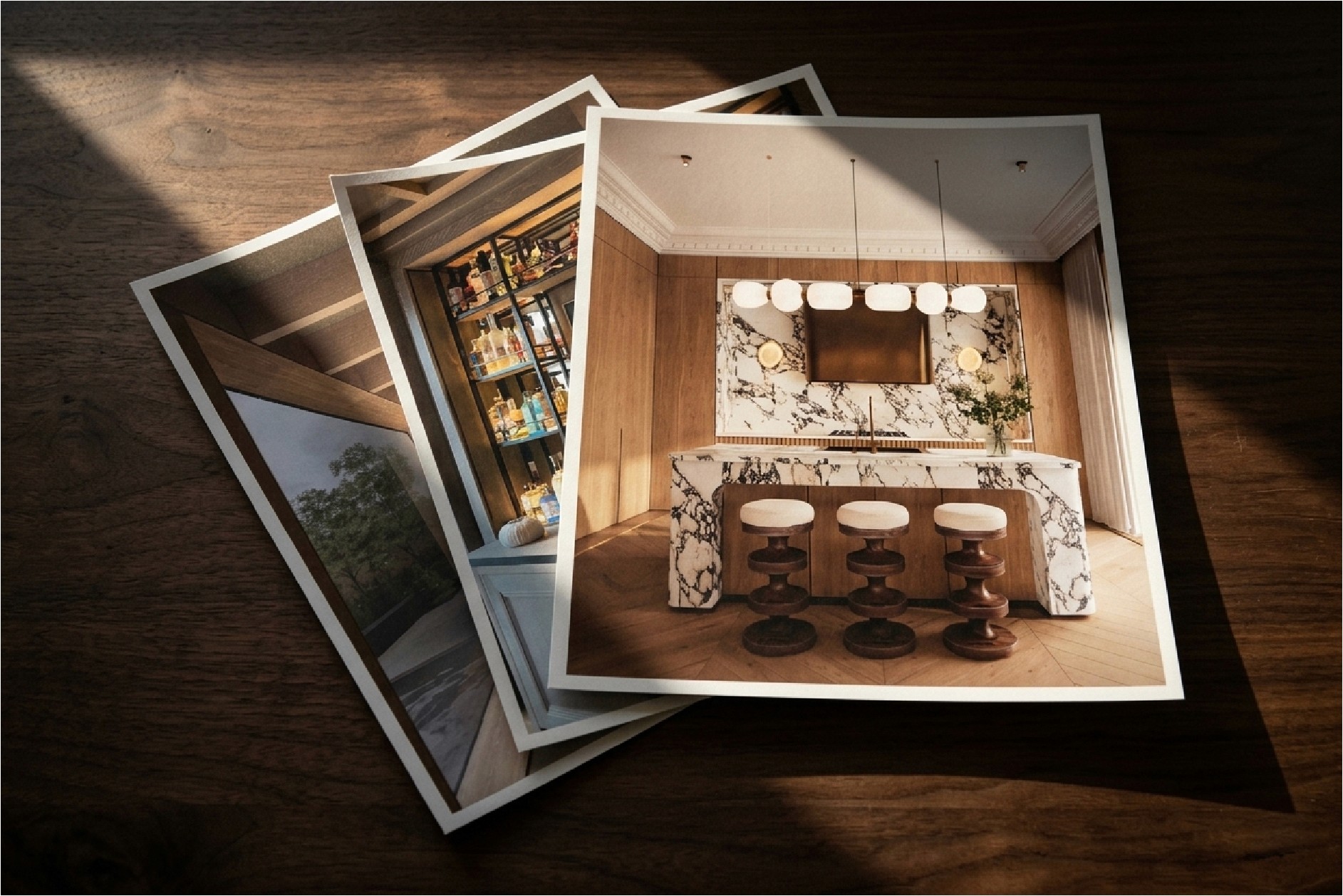
Making Vail feel present
Making Vail feel present
Everything we built chased one directive. Not a generic alpine mood that could belong to any mountain anywhere, but this place. The warmth of natural material against a cold landscape. The sense of arrival. We worked from references like these to fix the feeling before we modeled a single wall, because the difference between a render that sells and one that doesn't is rarely the geometry. It's the light, the texture, the truth of the material.
The model gave us the bones. Then came the part that matters: custom furniture instead of a generic package, real material depth instead of flat surfaces, late light streaming through the glass to give the sense of actually being there. Every render was built to answer the only question a remote buyer is really asking: does this feel worth it?
Everything we built chased one directive. Not a generic alpine mood that could belong to any mountain anywhere, but this place. The warmth of natural material against a cold landscape. The sense of arrival. We worked from references like these to fix the feeling before we modeled a single wall, because the difference between a render that sells and one that doesn't is rarely the geometry. It's the light, the texture, the truth of the material.
The model gave us the bones. Then came the part that matters: custom furniture instead of a generic package, real material depth instead of flat surfaces, late light streaming through the glass to give the sense of actually being there. Every render was built to answer the only question a remote buyer is really asking: does this feel worth it?
Showing it before it's real
Showing it before it's real
This was the work the whole brief pointed at. Not architecture explained, but a life made visible. A buyer two time zones away could look at these and know, before a single conversation, exactly what they would be coming home to.
This was the work the whole brief pointed at. Not architecture explained, but a life made visible. A buyer two time zones away could look at these and know, before a single conversation, exactly what they would be coming home to.


And then we made it move
And then we made it move
Stills convince. Motion commits.
The VR tours gave buyers something rarer than a picture, which was the ability to step inside a home that didn't exist, move through it, feel its proportions and its quiet. For someone deciding from afar, that's the difference between lingering interest and a signed contract.
Stills convince. Motion commits.
The VR tours gave buyers something rarer than a picture, which was the ability to step inside a home that didn't exist, move through it, feel its proportions and its quiet. For someone deciding from afar, that's the difference between lingering interest and a signed contract.
The walkthrough videos gave each unit a story instead of a frame: how the space opens, how light crosses it through the day, how it feels to come home.
And above all of it, the lifestyle films worked before any sales conversation began: the mountain, the seasons, the life. Because no one weighs square footage until they've already decided they want to live there.
The walkthrough videos gave each unit a story instead of a frame: how the space opens, how light crosses it through the day, how it feels to come home.
And above all of it, the lifestyle films worked before any sales conversation began: the mountain, the seasons, the life. Because no one weighs square footage until they've already decided they want to live there.
A website built to be walked through, not read
A website built to be walked through, not read
The site was never meant to be a brochure. It was built as a journey: draw the buyer in with the life, ground them in the product, build their trust in the team, make the next step obvious.
The writing followed the buyer's own arc. At this price, no one commits in a straight line. They move through aspiration, then scrutiny, then the quiet self-justification that comes right before a serious decision. Every line was written to carry them through all three without breaking the spell.
The site was never meant to be a brochure. It was built as a journey: draw the buyer in with the life, ground them in the product, build their trust in the team, make the next step obvious.
The writing followed the buyer's own arc. At this price, no one commits in a straight line. They move through aspiration, then scrutiny, then the quiet self-justification that comes right before a serious decision. Every line was written to carry them through all three without breaking the spell.
Even the contact form refused to feel like a form. Most ask you to fill in fields. This one asked you to write a note. Shaped like a stamped letter, sealed with the Apogean mark, it opened with "Hello" and closed with "Kind regards," so reaching out felt less like submitting a query and more like beginning a correspondence. A small thing. But at this level, the first message a buyer sends should feel as considered as the home they're sending it about.
Even the contact form refused to feel like a form. Most ask you to fill in fields. This one asked you to write a note. Shaped like a stamped letter, sealed with the Apogean mark, it opened with "Hello" and closed with "Kind regards," so reaching out felt less like submitting a query and more like beginning a correspondence. A small thing. But at this level, the first message a buyer sends should feel as considered as the home they're sending it about.
And because trust at this level is also about people, the interactive property module laid every available unit, configuration, and price in one clear place, with no friction and no chasing the sales team. The team bios were written to make the people behind the build as credible as the build itself. At this level, a buyer isn't only buying a home. They're betting on whoever's making it.
And because trust at this level is also about people, the interactive property module laid every available unit, configuration, and price in one clear place, with no friction and no chasing the sales team. The team bios were written to make the people behind the build as credible as the build itself. At this level, a buyer isn't only buying a home. They're betting on whoever's making it.
The test every image had to pass
The test every image had to pass
Nothing shipped until it survived one question, asked over and over through every round of review: does this feel like Vail? Not "is this technically correct," because a buyer making a serious decision doesn't care about technical. They care whether something feels real enough to trust. Does this material belong at this price? Does this angle show the space the way you'd actually live in it?
The frames that didn't feel true went back. That's the only standard that matters when belief is the entire product. It's also where the work was won or lost, in the last five percent: the linen texture on a footer that turns flat into sumptuous, the exact place the light lands inside a room. Small things. The whole thing.
Nothing shipped until it survived one question, asked over and over through every round of review: does this feel like Vail? Not "is this technically correct," because a buyer making a serious decision doesn't care about technical. They care whether something feels real enough to trust. Does this material belong at this price? Does this angle show the space the way you'd actually live in it?
The frames that didn't feel true went back. That's the only standard that matters when belief is the entire product. It's also where the work was won or lost, in the last five percent: the linen texture on a footer that turns flat into sumptuous, the exact place the light lands inside a room. Small things. The whole thing.
The work, off the screen
The work, off the screen
The renders and films didn't only live online. They filled the room buyers walked into: Apogean's Vail showroom, where the same materials and furnishings we'd visualized were echoed in physical space, the digital and the real finally standing in for each other.
The renders and films didn't only live online. They filled the room buyers walked into: Apogean's Vail showroom, where the same materials and furnishings we'd visualized were echoed in physical space, the digital and the real finally standing in for each other.

The outcome
The outcome
When the site launched, Vail answered immediately. Buyers engaged seriously. The project started generating conversations it hadn't formally invited yet, and for a nine-unit residence that didn't physically exist, that early pull is the whole point of the presales window.
When the site launched, Vail answered immediately. Buyers engaged seriously. The project started generating conversations it hadn't formally invited yet, and for a nine-unit residence that didn't physically exist, that early pull is the whole point of the presales window.
"With pre-construction, your renderings are what you have to show. You don't have a property, so you need to prove you get it. A lot of companies can't, you get generic furniture and flat walls. HEED did the custom furniture, the textures, the light through the windows that makes you feel like you're there. They nailed it.
We interviewed several companies, and nobody does everything they do, from start to finish. It was an easy choice.
They never pushed us back, only pulled us forward, from 90% to 100%. No ego. And when I walked into the showroom, it was like stepping into one of their renderings. They could have fooled me."
-Rebekah Zenor
Broker, Compass · Apogean Vail
"With pre-construction, your renderings are what you have to show. You don't have a property, so you need to prove you get it. A lot of companies can't, you get generic furniture and flat walls. HEED did the custom furniture, the textures, the light through the windows that makes you feel like you're there. They nailed it.
We interviewed several companies, and nobody does everything they do, from start to finish. It was an easy choice.
They never pushed us back, only pulled us forward, from 90% to 100%. No ego. And when I walked into the showroom, it was like stepping into one of their renderings. They could have fooled me."
-Rebekah Zenor
Broker, Compass · Apogean Vail

Let’s bring
your vision to life

Copyright © 2026 Heed agency. All rights reserved.
Let’s bring
your vision to life
Copyright © 2026 Heed agency. All rights reserved.
Let’s bring
your vision to life
Copyright © 2026 Heed agency. All rights reserved.
Let’s bring
your vision to life
Copyright © 2026 Heed agency. All rights reserved.